

Begić v. Bosnia and Herzegovina, No. 5067/23, ECtHR (Fourth Section), 3 February 2026
The judgment delivered by the European Court of Human Rights (ECHR) on 3 February 2026 in the case Begić v. Bosnia and Herzegovina (No. 5067/23, Fourth Section) follows the well-established line of Strasbourg case law on ethnic discrimination in access to public office. It constitutes a further critical stance towards the post-Dayton constitutional framework of Bosnia and Herzegovina, which is considered difficult to reconcile with the principles of substantive equality and non-discrimination enshrined in the Convention, in particular in Article 1 of Protocol No. 12.
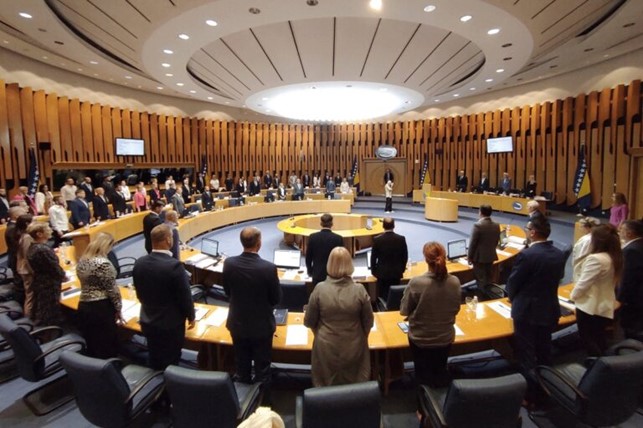
The case stems from the situation of a member of the House of Representatives belonging to the residual category of “Others”, that is to say, not attributable to the three constituent peoples (Bosniaks, Croats and Serbs). The applicant had been nominated for the office of Speaker or Deputy Speaker of the House; however, his candidacy was not even put to a vote by the assembly, as it was deemed incompatible with the current legal framework, which reserves such positions exclusively for members of the main ethnic groups.
Believing that he had been automatically excluded for reasons linked to his ethnic origin (or, rather, for not having claimed it), the applicant turned to the ECHR, alleging a violation of the right to participate in public life on an equal footing. The respondent State, on the other hand, justified the contested system by referring to the specific features of the historical and institutional context in Bosnia and Herzegovina, highlighting how the mechanisms of ethnic representation served to maintain political balance and post-war stability.
As a preliminary point, the Court recognised the applicant’s standing, clarifying that he was acting not as a representative of a state body, but as an individual directly affected by the contested legislation, within the meaning of Article 34 of the ECHR. His status as a victim was also confirmed, as his exclusion from the decision-making process had occurred immediately and without any discretionary assessment.
The Court then rejected the government’s objection regarding the failure to exhaust domestic remedies, noting that, in similar cases, an appeal to the Constitutional Court of Bosnia and Herzegovina does not constitute an effective remedy. That body has, in fact, consistently ruled out its own jurisdiction to review the conformity of the Constitution with the Convention, resulting in a gap in protection at the domestic level which justifies the direct appeal to Strasbourg.
On the merits, the European judges found a clear disparity in treatment between individuals in a similar position – all members of the same parliamentary assembly – based solely on ethnic origin. In line with its case law, the Court reiterated that distinctions of this kind may be permitted only where there are particularly rigorous justifications and, in any event, cannot persist indefinitely within a democratic system.
The ruling forms part of a now well-established line of case law. As early as the case of Sejdić and Finci v. Bosnia and Herzegovina (2009), the Court had criticised the exclusion of citizens not belonging to the constituent peoples from the main state offices; this approach was subsequently confirmed in Zornić v. Bosnia and Herzegovina (2014) and in Pilav v. Bosnia and Herzegovina (2016), which progressively broadened the scope of relevant discrimination. More recently, the Grand Chamber, in the case Kovačević v. Bosnia and Herzegovina (2025), called into question the overall structure of the electoral system, highlighting its structurally ethnic nature. The 2026 judgment continues this line of reasoning, extending the review to the internal organisation of parliamentary bodies as well.
A significant passage in the judgment concerns the rejection of the State’s argument that the posts in question play a merely secondary role. The Court clarified, albeit implicitly, that the significance of the violation does not depend on the institutional weight of the post, but on the principle of equality that has been compromised: exclusion based on ethnicity is, in itself, incompatible with the values of the Convention.
The decision also highlights, once again, the friction between the constitutional order of Bosnia and Herzegovina and the European Convention system. Despite the formal primacy of the Convention in domestic law, the absence of effective mechanisms to ensure its application – partly due to the position of the Constitutional Court – results in a persistent inability on the part of the State to implement the rulings from Strasbourg.
Ultimately, the Begić judgment reinforces the Court’s approach aimed at urging a transformation of the Bosnian-Herzegovinian system towards a more inclusive model, moving beyond a system of representation rigidly based on ethnicity in favour of a concept founded on citizenship. Whilst acknowledging the historical reasons underlying the current structure, the Court reiterates that such requirements cannot justify the indefinite maintenance of discriminatory regimes. The State’s failure to adapt to this line of case law therefore amounts to a repeated violation of the Convention and an obstacle to the full development of a pluralist and egalitarian democracy.
(Comment by Edin Skrebo)